
VIDEO 8 · HI8 · DIGITAL 8
The 8mm camcorder
The 8mm camcorder
tape family.
Three formats, one shell: analog Video8, sharper Hi8, and fully digital Digital8. Captured on professional equipment from $7.50 per tape. MP4 H.264 output, delivered on DVD, BluRay or via 1-year cloud streaming (you pick at checkout). Free pickup in Portland metro, mail-in nationwide.
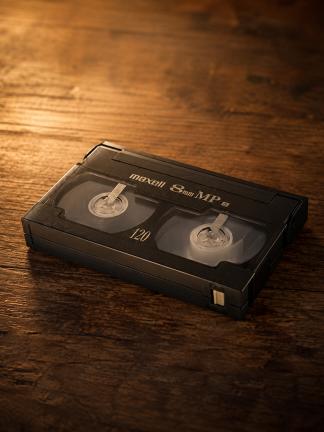
i. The family
Same shell, three technologies.
You can’t tell them apart by looking. The recording format is what differs, and what determines the captured quality.
-
Video8
The original 8mm analog camcorder format from the late 1980s. Roughly 270 horizontal lines of resolution, similar to VHS. Common in early home camcorders.
-
Hi8
Higher-resolution analog 8mm from the early 1990s: around 400 lines, comparable to S-VHS. Dominant in 1990s consumer camcorders. Same shell as Video8 but different magnetic formulation.
-
Digital8
Digital recording on Hi8 tape from the late 1990s into the 2000s. DV-quality video (~500 lines). Cameras were backwards-compatible with Video8 and Hi8 playback, but the recording format is fully digital.
ii. What we deal with
8mm has its own failure modes.
Thinner tape, denser recording. The wear shows up differently than on VHS.
-
Tape stretch and crumpling
8mm tape is thinner than VHS and more prone to physical damage. Worn camcorders that ate tape often left visible creases. Advanced scans re-pass damaged sections at varied transport speeds.
-
Dropout and signal loss
8mm magnetic surface degrades faster than VHS in poor storage. Color dropouts and brief blackouts are common in tapes over 25 years old. Advanced capture catches what’s recoverable.
-
Audio sync issues
Hi8 and Digital8 cameras sometimes recorded audio with drift relative to video. We correct sync during Advanced processing.
-
Mold and storage damage
Common in tapes stored in basements or garages. Mold is restorable; severely-damaged shells may need transplanting. Free quote before any restoration work.
iii. Reading the shell
What the markings on your cassette mean.
An 8mm label carries more useful information than people expect. Here’s how to decode it before you even count your tapes.
-
MP vs ME
Two tape formulations. MP (Metal Particle) is the workhorse: durable, ages predictably. ME (Metal Evaporated) recorded sharper, especially on Hi8, but the coating is thinner and more fragile: ME tapes show dropouts and edge damage sooner. If your label says ME and the recordings matter, move them up the priority list.
-
The number is minutes, mostly
P5-90, 120, similar codes: recording length in minutes at standard speed. LP mode doubled it at a quality cost, the same trade VHS made with EP. A “120” tape recorded in LP holds up to four hours of footage, and the per-tape price here covers all of it.
-
Hi8 XR and other suffixes
XR (“extended resolution”) marks late-generation Hi8 with a modest sharpness bump. Digital8 shells sometimes carry a plain Hi8 label because the format lived in the camera, not the cassette. When in doubt, our decks identify the actual recording on receipt: you don’t need to be right on the order form.
-
NTSC or PAL
Tapes recorded abroad are often PAL. We capture NTSC, PAL and SECAM on multi-system equipment at the same price; just mention it if you know the footage came from another country.
iv. The playback path
Why 8mm rewards the right equipment.
The 8mm family is less forgiving of casual capture than VHS. Three reasons the playback chain matters more here.
-
Denser recording, smaller margins
8mm packs a similar signal onto tape half the width of VHS. The same speck of dust or worn head that VHS shrugs off becomes a visible dropout on 8mm. Clean transports, fresh heads and dropout compensation earn their keep on this format.
-
Analog 8mm still needs a TBC
Video8 and Hi8 are analog signals with the same timing instability as VHS: wobble, tearing, unstable color on worn tape. We run them through the same time base correction chain as VHS: Line TBC on Basic, Full-Frame TBC on Advanced.
-
Digital8 goes straight to data
Digital8 skips the analog chain entirely: the DV stream transfers losslessly over FireWire, bit-for-bit what the camera recorded, encoded once for delivery. The same path our MiniDV capture uses.
v. The process
How we capture 8mm.
Five passes between your tape arriving and your archive heading back to you.
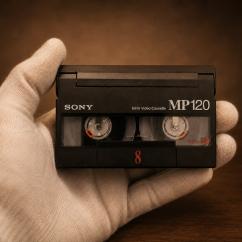
Inspect & clean
Visual check of shell, leader and tape surface. Dust and debris cleared from the path before powering up the deck.
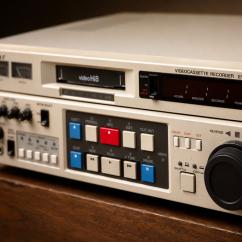
Capture
Basic or Advanced, whichever you chose when ordering. Basic is professional A/V capture in two to five business days; Advanced is lossless capture on specialized hardware with Advanced deinterlacing. Captures appear in your dashboard as soon as they’re ready.

Advanced on demand
Ordered Basic? Pick a whole clip or just part of it in your dashboard and order an Advanced re-scan for it, the same way you add AI Enhancement.

Discs & cloud
Download your files from the dashboard: for 30 days after your order is completed with discs, or throughout your cloud subscription plus 30 days after it ends. We also burn them to DVD or BluRay (your choice), or, if you picked cloud access, watch them in a streaming app, just like Netflix, once you sign in with your account.

Tapes returned
Your original cassettes come back together with the discs when those were ordered.
8mm tapes from the 1990s are now hitting the end of their reliable storage life. The next decade gets harder, not easier.
Q. & A.
8mm tape questions.
The five asked most often. A longer set→ covers everything else.
Check the label: "Hi8" and "Digital8" are usually printed. Plain 8mm without those labels is Video8. If you’re unsure, don’t worry. We identify the format on receipt. Pricing is the same across all three. For every other cassette in the box, our tape identification guide helps.
Yes. Digital8 is captured digitally via FireWire transfer from a Digital8 camera or deck. The data is preserved exactly as recorded, then encoded once for delivery.
Yes. We have our own playback equipment for all three 8mm variants. You only send the tapes.
Yes. Digital8 is roughly DV-quality (~500 lines) versus Hi8’s ~400 lines analog. The clarity difference is visible side by side. Both are improved further by AI upscaling.
Often yes. Crumpled or pulled tape can be repaired and captured carefully. Severe damage might be partial-recovery only. We inspect and quote restoration if the tape needs it.
Pricing starts at $25 for 2 tapes.
Same Basic and Advanced structure as the rest of our service. Use the calculator for live totals. Worried about tape condition? Read about sticky-shed syndrome on Video8 and Hi8 tapes.
See Pricing