
VHS · VHS-C · S-VHS
Convert VHS
Convert VHS
tapes to digital.
Full-size VHS, compact VHS-C and higher-resolution S-VHS, captured on professional equipment. From $7.50 per tape. MP4 H.264 output, delivered on DVD, BluRay or via 1-year cloud streaming (you pick at checkout). Free pickup in Portland metro, mail-in nationwide.
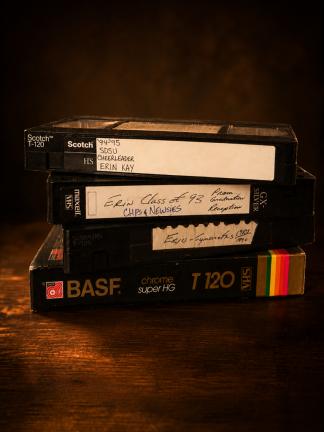
i. The family
Three shells, one technology.
Same magnetic tape underneath. The shell (and the resolution it can hold) is what differs.
-
VHS
The standard full-size cassette used in home VCRs from the late 1970s through the early 2000s. Tape lengths from 30 minutes up to T-180 (3 hours) at standard play, longer in extended-play modes. We handle all SP, LP and EP recordings.
-
VHS-C
The compact format used in palm-sized camcorders. The tape itself is identical to VHS, just in a smaller shell. We use proper adapter cassettes for capture; you don’t need to send your camcorder.
-
S-VHS
The higher-resolution variant: roughly 400 horizontal lines instead of standard VHS’s 240. Common in prosumer camcorders. We capture in S-VHS mode using S-VHS-capable decks for the full quality benefit.
ii. What we deal with
Three decades of storage take a toll.
Here’s what we encounter on most VHS tapes, and what each tier of our service does about it.
-
Tape stretch and dropouts
Worn tape produces playback noise: sparkles, lines, audio glitches. Basic capture preserves them as-is. Advanced re-captures the worst sections at different transport speeds and selects the cleanest read.
-
Color shift and fading
VHS color is the first thing to degrade. Advanced scans include calibrated color correction and white balance recovery. Heavy fading is unrecoverable past a point, but often improves more than expected.
-
Audio hiss and level issues
Standard VHS audio is famously thin. Advanced includes noise reduction and level normalization. Hi-Fi tracks (when present) are captured separately for the best quality.
-
Mold and sticky-shed
Damp storage causes mold; some tape formulations develop sticky-shed syndrome. Both are restorable but billed separately. We send a free quote before any work and never proceed without your approval.
iii. The equipment
Why the deck decides the result.
Two captures of the same tape can look like different tapes. The difference is almost never the software. It’s the playback chain.
-
Time base correction, in plain words
A VCR never plays a tape at a perfectly steady rate: the tape stretches, the motor drifts, and every line of the picture arrives slightly early or late. On screen that reads as wobbly verticals, tearing at the top of the frame and unstable color. A time base corrector re-times the signal. Basic uses Line TBC, correcting line by line; Advanced uses Full-Frame TBC, holding entire frames steady, which is what worn tapes usually need.
-
Hi-Fi audio, when the tape has it
Many VHS recordings carry two soundtracks: a thin linear track and a much better Hi-Fi track buried in the video signal. Consumer capture boxes usually grab whichever comes out of the RCA jack. We monitor both and capture the Hi-Fi track when it’s present and clean, falling back to linear when Hi-Fi has switching noise.
-
Heads, alignment and the last VCR standing
The video heads in a deck wear like tires. A tired living-room VCR plays a healthy tape as a snowy one, and an eBay VCR of unknown mileage is a gamble with an irreplaceable recording. Our decks are serviced, aligned and checked against reference tapes, which is most of what “professional capture” actually means.
iv. The process
How we capture VHS.
Five passes between your tape arriving and your archive heading back to you.
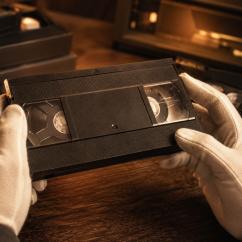
Inspect & clean
Visual check of shell, leader and tape surface. Dust and debris cleared from the path before powering up the deck.
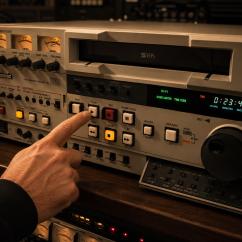
Capture
Basic or Advanced, whichever you chose when ordering. Basic is professional A/V capture in two to five business days; Advanced is lossless capture on specialized hardware with Advanced deinterlacing. Captures appear in your dashboard as soon as they’re ready.
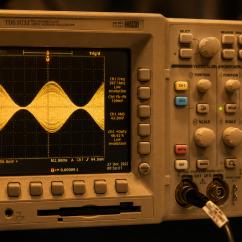
Advanced on demand
Ordered Basic? Pick a whole clip or just part of it in your dashboard and order an Advanced re-scan for it, the same way you add AI Enhancement.
Discs & cloud
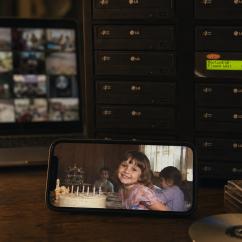
Download your files from the dashboard: for 30 days after your order is completed with discs, or throughout your cloud subscription plus 30 days after it ends. We also burn them to DVD or BluRay (your choice), or, if you picked cloud access, watch them in a streaming app, just like Netflix, once you sign in with your account.
Tapes returned
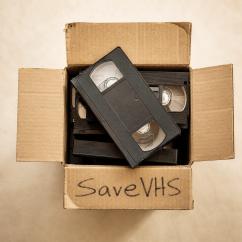
Your original cassettes come back together with the discs when those were ordered.
Pricing starts at $25 for 2 tapes.
The per-tape rate drops as you add more. Use the calculator for live totals across Basic and Advanced packages.
See Pricing
v. What you get
Files, discs, cloud: your choice.
Every package includes a disc set or cloud streaming, plus MP4 downloads.
-
MP4 H.264 files
Standard resolution preserved (480i for NTSC, 576i for PAL). Plays everywhere: phone, tablet, smart TV, computer, in browsers, in editing software.
-
Cloud, DVD or BluRay
At checkout, choose 1 year of cloud streaming (watch in an app, just like Netflix), or a disc set (DVD or BluRay) with menus you arrange yourself in the dashboard. All three are included at the same price. Pick what fits your viewing habits.
-
Optional 1080p upscale
Before your order is completed, mark portions in the dashboard for AI Enhancement to 1080p FullHD. $0.30 per minute of selected video on an Advanced capture, $0.35 on a Basic capture (AI needs the Advanced re-scan underneath, so it’s included).
VHS color is the first thing to degrade. The next decade tends to bring rapid loss. Digitizing now is the right call.
Q. & A.
VHS questions.
The six asked most often. A longer set→ covers everything else.
No. Our decks auto-detect and play all three speeds. The recording quality differs (EP is lowest resolution and most prone to dropouts), but capture handles all three the same way.
Yes. Multi-system decks. Just let us know what we’re getting. Most NTSC and PAL tapes are obvious from the label, but contact us if you’re unsure.
No. We use professional VHS-C-to-VHS adapter cassettes. Just send the tapes.
Yes, if recorded in S-VHS mode. The horizontal resolution is roughly 1.7× higher and color is cleaner. Note that S-VHS-C is captured at S-VHS quality.
Measure it: a VHS shell is about 7.4 inches wide and fits a VCR. Smaller cassettes are VHS-C, 8mm family or MiniDV. Our tape identification guide sorts every consumer format by size and shell details in a minute.
10 to 25 years of clear playback in average storage. Cool, dry conditions extend that significantly. If your tapes are pushing 30+ years, digitizing now is the right call: the next decade tends to bring rapid degradation.
Save your VHS tapes while you can.
Magnetic tape degrades a little every year. We can help while the signal is still there to save. Curious about the science? Read how long VHS tapes really last and what sticky-shed syndrome does to tape.
Get Started